
Here’s my talk (including the Q&A session) about SPARKNaCl from FOSDEM yesterday…
Author Archives: Rod Chapman
SPARKNaCl seminar for Bristol Cyber CDT/Crypto groups
Last week, I was able to visit the University of Bristol CyberSecurity CDT and Cryptography groups to give a long-overdue seminar about SPARKNaCl. The talk goes into the motivation for development SPARKNaCl in the first place, the formal verification of the code, and the subsequent performance optimization work. The CDT staff were able to record the seminar and it’s now available here.
Performance Analysis and Tuning of SPARKNaCl
New Third phase of performance analysis, improvement, and porting the library to GNAT and SPARK Community 2021 is written up here.
Second phase of performance analysis is now written up here.
I’m pleased to say that I’ve finished the first phase of performance analysis and tuning of the SPARKNaCl library. This has been something of a marathon, and touched on all sorts of interesting topics with SPARK, proof, language design, compiler internals, and the details of the RISC-V ISA and its implementation.
The write-up is on AdaCore’s blog as before. This is the most nerdy/technical thing I’ve worked on and written for ages, but please have a look. TL;DR version: formal is fast!
You can see all the updates and tagged snapshots of the code as I worked on it on SPARKNaCl’s GitHub Repo.
An update for SPARKNaCl in the ALIRE package manager will follow shortly.
Introducing SPARKNaCl – a verified crypto library
Here’s some new software that I’ve been working on in my spare time over the last few months. I’ve decided to make the code freely available under the simplified BSD licence.
SPARKNaCl is a SPARK 2014 implemenation of the NaCl cryptographic library, based on the minimalistic TweetNaCl code from Daniel J. Bernstein and his colleagues.
SPARKNaCl has been verified “type-safe” (aka “no runtime errors”) by the SPARK toolset, and the proof is fully “auto-active” meaning the standard set of provers discharge every single verification condition, with no interactive proof at all, based solely on the contracts in the code and nothing else. In addition, some interesting correctness properties have been verified en-passant.
This was all something of a challenge – cryptographic code like TweetNaCl sets some particularly difficult challenges for both the human brain and for automated verification tools alike. Read all about it here.
Video from BrisTech 2018 – Building Software like it Matters…
Here’s the video from a talk that Neil White and I gave at BrisTech 2018 just before Christmas. BrisTech has grown into a great event in the last few years, with a big audience, a great venue, and a lot of competition for speaking slots.
Neil is Director of the Intelligent Systems Expertise Centre at Altran UK in Bath – the business that we used to call “Praxis” back in the day. He opens the talk by setting the scene and what makes critical software development so different, before I dive into the technical stuff regarding SPARK, static verification, and so on.
SSS Keynote – The Fumble Programmer
Here’s my recent keynote paper and talk from the SCSC SSS 2018 conference in York. The paper and slides are here for now. Video might follow in the near future.
Abstract: This paper reflects on the need for formality, discipline and humility in programming. Starting with the work of Turing, Dijkstra and Humphrey, this paper goes on to cover our experience with the Personal Software Process, formal programming with SPARK, and the impact of putting the two together.
The full reference is:
R. Chapman, “The Fumble Programmer” Invited Keynote Paper. Proc of the 26th Safety Critical Systems Symposium, York, UK, Feb 2018. pp. 143-154. Safety Critical Systems Club, UK. ISBN 978-1-9797-3361-8.
High-Integrity Agile in CACM
For some time, I’ve been working with Altran UK on how we can use, improve and deploy Agile approaches in the development of high-integrity software. We’ve presented our ideas at SCSC events and at the SSS conference with encouraging feedback, so we wrote it up as a Viewpoint article for CACM, which appeared here today.
I’d like personally thank Moshe Vardi for the encouragement to give this a go in the first place, and diligent reviewing of the manuscript from Bertrand Meyer.
Articles from Royal Society “Verified trustworthy software systems” meeting now published
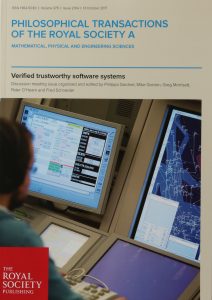 Last April, there was a discussion meeting at the Royal Society on “Verified trustworthy software systems.” The attendance and speakers were something of a who’s-who of the software verification community. The resulting issue of Royal Society Transactions A is now in print and on-line.
Our paper, co-authored with Neil White and Stuart Matthews from Altran UK, covers our experiences with building and applying formal verification to real-world industrial systems, and considers the incentives and barriers that seem to be holding back wider adoption of such technology. The full text is available on request from me by email.
New paper: Sanitizing sensitive data: how to get it right (or at least less wrong…)
Here’s the paper that I presented at Ada Europe this week in Vienna.
It deals with the tricky issue of how to erase or “sanitize” data in running software, so that it can’t be observed. Many coding standards and guidance documents for secure software say that we should do this for “sensitive” data such as the plaintext of passwords, cryptographic keys, and so on, but offer very little technical advice on how to do it properly. I had to implement this kind of thing for a recent development project and it turns out to be much harder to get right than you might think. The paper describes why it’s hard, what you can do about it.
Post conference note: the “further work” section proposes a special compiler switch that automatically erases local data before it goes out of scope. Recently, I have discovered that this has actually been implemented in LLVM by the team at Embecosm. See their blog entry here for details. It doesn’t look like their work has been contributed upstream to the main LLVM sources yet.
Stop press: I was awarded “Best presentation” for my talk on this work.
Think you know C? Think again…
There’s a great article in the latest issue of ACM Queue about the effects of uninitialized variables in C by Robert Seacord. See here https://queue.acm.org/app/
Robert is a noted expert and was the principal author of the CERT C Coding Standard, so he really does know what he’s on about. The good news: the article is the most complete and up-to-date treatment of this topic that I know of – I certainly learned lots from it, especially with regard to what C’11 has to say. The bad news: it’s worse, much worse, than you think…
Question: would it be possible to define a subset of C which is both useful and guarantees sound data-flow analysis in P-Time? I fear the answer is “no”… ho hum… I’ll stick to SPARK thanks… 🙂